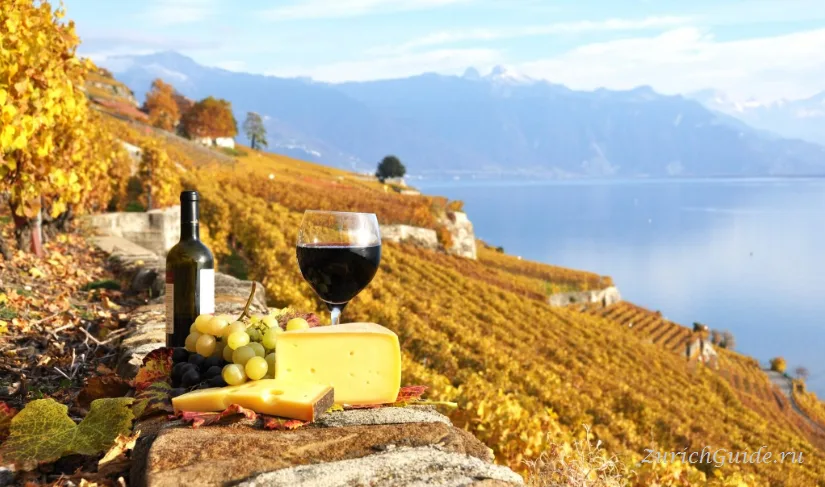
Eat and drink
Cheese in three forms, a chocolate industry, wine almost nobody exports, and the trick to eating here without being fleeced.
Swiss cooking is regional to a degree that surprises people: what is eaten in Lugano has nothing in common with what is eaten in Zurich, because one is Lombard and the other is Alemannic and neither is trying to be Swiss.
What holds it together is dairy. This is a country that turned mountain pasture into cheese because cheese keeps and milk does not, and almost every national dish is a way of eating it.
The three cheese dishes
Fondue — melted cheese and white wine in a pot, bread on long forks. A winter dish, eaten in the evening, and not with beer or cold water if you believe the folklore. The Fribourg version, moitié-moitié, is half Gruyère and half Vacherin Fribourgeois, and is the one to have.
Raclette — half a wheel of cheese melted at the cut face and scraped onto potatoes, with pickles. Simpler than fondue and, most Swiss would say, better.
Älplermagronen — the herdsman’s macaroni: pasta, potato, cheese, cream and fried onion, with apple sauce on the side. Mountain food, and the thing to order after a long walk.
Regional dishes worth ordering
- Zürcher Geschnetzeltes — veal in cream and white wine with rösti, in Zurich
- Berner Platte — a mound of boiled meats and beans in Bern
- Papet vaudois — leeks and potatoes with a sausage, in Vaud
- Filets de perche — lake perch, fried, around Geneva and Neuchâtel
- Risotto and polenta — Ticino, eaten in a grotto under the trees
- Bündnerfleisch — air-dried beef sliced thin, from Graubünden
- Cervelat — the national sausage, grilled over a fire with the ends cut into a cross
Chocolate
Switzerland eats more chocolate per head than anywhere else, and invented the two techniques that made modern chocolate: milk chocolate, by Daniel Peter in Vevey in 1875, and conching, by Rodolphe Lindt in Bern in 1879, which is what makes it smooth.
Buy it in a supermarket rather than a souvenir shop — the same bars cost a third as much. For the good stuff, a chocolatier: Sprüngli in Zurich, Läderach, or the factory at Broc near Gruyères.
Wine
Switzerland drinks almost all of what it makes — about 98% never leaves the country — which is why you have probably never had it and why it costs what it does.
The main regions: Lavaux and the Valais for whites, mostly Chasselas; Ticino for Merlot; Graubünden for Pinot Noir. Chasselas is the one to try, because almost nowhere else takes it seriously as a wine grape.
Beer, and the rest
Local breweries in every canton, and Appenzeller Quöllfrisch is the one that travels. Rivella, made from milk whey, is the national soft drink and tastes better than that description. And Ovomaltine, which the British know as Ovaltine, was invented in Bern.
Eating without being fleeced
Restaurants are expensive and there is no way round it, but:
- Lunch menus — the same kitchen at a fraction of the evening price
- Supermarkets — Coop and Migros do genuinely good hot food, and the branches in main stations open late and on Sundays
- Tap water — free everywhere, including from the street fountains
- Service is included and prices are final; tipping is rounding up, not a percentage
More in money in Switzerland.
Updated: