Bern
The federal capital, which almost nobody outside Switzerland guesses correctly, with six kilometres of arcades and a river you can swim down.
Bern is the seat of the Swiss government, and the fact surprises almost everyone — Zurich is bigger, Geneva is more famous, and neither is the capital. Bern got the job in 1848 precisely because it was the compromise nobody objected to, and it has stayed modest about it ever since.
The old town is UNESCO-listed, and it earns that in a specific way: about six kilometres of covered arcades, the longest continuous run in Europe, sheltering shops and cafés along almost every street in the centre. It rains here; the arcades mean you can spend a wet day outdoors.
The whole thing sits inside a hairpin bend of the Aare, a river of startling glacial green, with high bridges over it and the Alps on the skyline behind.
What to see
Zytglogge
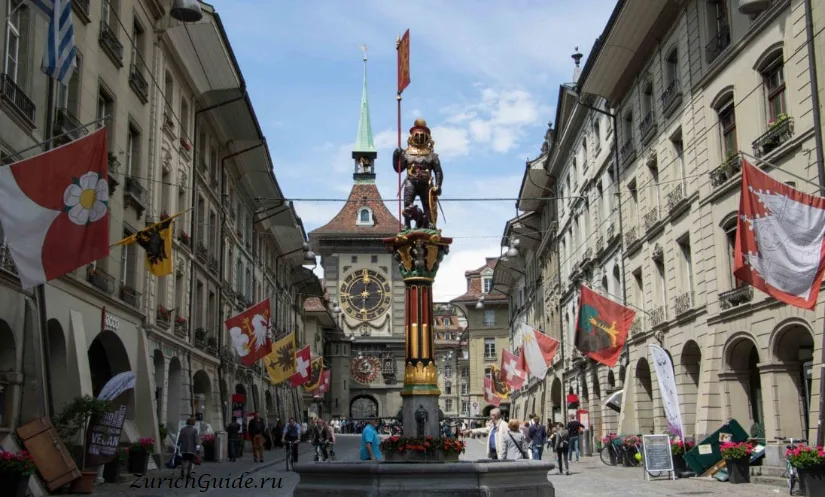
The clock tower on Kramgasse, and the centre of everything. It was the western gate of the city in 1218, became a prison, burned, and got its astronomical clock in 1530 — which still runs, and still puts on a small show of jesters, bears and a crowing cock four minutes before every hour.
The crowd gathering at ten to the hour is how you find it.
Einstein lived at Kramgasse 49, a hundred metres away, and wrote the special theory of relativity there in 1905 while working at the patent office. The flat is a small museum.
The fountains
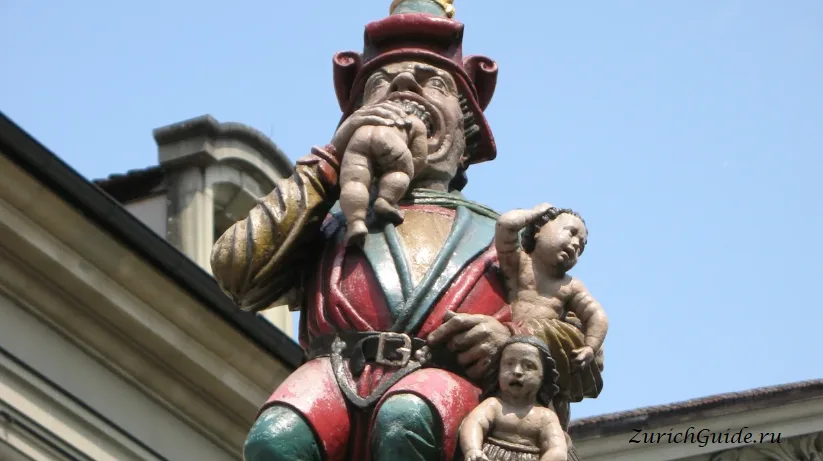
Eleven sixteenth-century figured fountains stand along the old town streets, brightly painted and mostly on their original columns. They were the city’s water supply and its public art at once.
The one everybody photographs is the Kindlifresserbrunnen — the Child Eater — an ogre stuffing an infant into his mouth with more in a sack. Nobody is sure what it means. The politest theory is that it warned children away from the river; the others are less comfortable, and the city has argued about it for four hundred years.
Others worth finding: the Zähringerbrunnen with its armoured bear, and the Gerechtigkeitsbrunnen, Justice blindfolded, standing on the severed heads of a pope, a sultan and an emperor.
Bundeshaus
The parliament building, and unusually approachable: free guided tours run when the chamber is not sitting, and you can watch debates from the gallery.
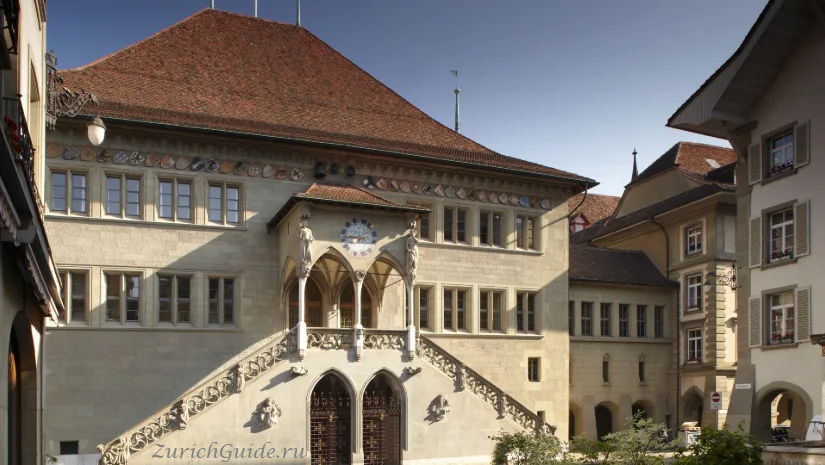
The square in front, Bundesplatz, has 26 fountains set into the paving — one for each canton — that spray in sequence and which children treat as a paddling pool all summer. In late autumn the facade becomes the screen for the Rendez-vous Bundesplatz light show.
The Münster
The Gothic cathedral, begun in 1421 and not finished until 1893. Its tower is the tallest in Switzerland at 100 m, and 344 steps get you to the top for the best view of the river bend.
The main portal carries a Last Judgment with 234 figures — one of the few large sets of medieval sculpture in Switzerland to survive the Reformation intact, because the reformers here decided it was outside the church and therefore not idolatry.
The bears
Bern means bear, and the city has kept them since 1513. The BärenPark below the Nydeggbrücke replaced the old pit in 2009 with a hillside enclosure running down to the river.
There are usually two or three, and they are visible from the path along the Aare — no ticket needed.
Rosengarten
Cross the bridge and climb ten minutes for the standard view of Bern: the whole old town inside its river loop, roofs and towers, the Alps behind. Free, and best in the late afternoon.
Floating down the Aare
The most Bernese thing there is. On a summer afternoon half the city walks upstream to Eichholz or Marzili, gets into the river, and lets the current carry it back through town to the Marzili baths, where you climb out on the handrails by the parliament building.
It is free, the water is clean, and the locals do it in a lunch hour.
It is also genuinely dangerous if you get it wrong. The Aare is fast, cold and glacier-fed, and people drown in it every year. The rules the city posts are worth respecting: do not go in unless you are a strong swimmer, never after drinking, get out at the marked exits because the next one is a long way down, and go with someone who has done it before. If in doubt, swim in the Marzili pools instead, which are free and beside the river.
Getting there
- By train — Zurich to Bern is under an hour, several an hour. Geneva is an hour and three quarters, Basel an hour, Interlaken under an hour.
- On foot from the station — the old town starts immediately outside it, and everything on this page is within a twenty-minute walk.
- By car — there is no reason. The centre is largely pedestrian and parking is expensive.
Bern also sits on the language border: German is spoken here, French begins twenty minutes west, and the local dialect is thick enough that Swiss Germans from elsewhere enjoy imitating it.
What to eat
Bernese cooking is farm food. The Berner Platte is the emblem: a mound of boiled meats, sausages, bacon, beans and potatoes, invented — the story goes — to celebrate a victory in 1798, and still served in portions built for someone who has been outdoors all day.
Also local: Emmentaler, from the valley half an hour east, and the Züpfe bread plaited for Sunday breakfast.
Around Bern
- Thun — 20 minutes, a castle and a lake
- Fribourg — 25 minutes, and across the language border
- Interlaken and the Jungfraujoch — under an hour to Interlaken Ost
- Emmental — the valley, the cheese dairy, and the covered wooden bridges
When to go
Summer for the river and the fountains, and because the arcades keep the rain off when it comes. December for the Christmas market on Waisenhausplatz and the light show on the parliament. The fourth Monday in November for the Zibelemärit, the onion market — an all-day fair that starts at four in the morning and involves confetti, onion tarts and a great deal of mulled wine.
Updated: