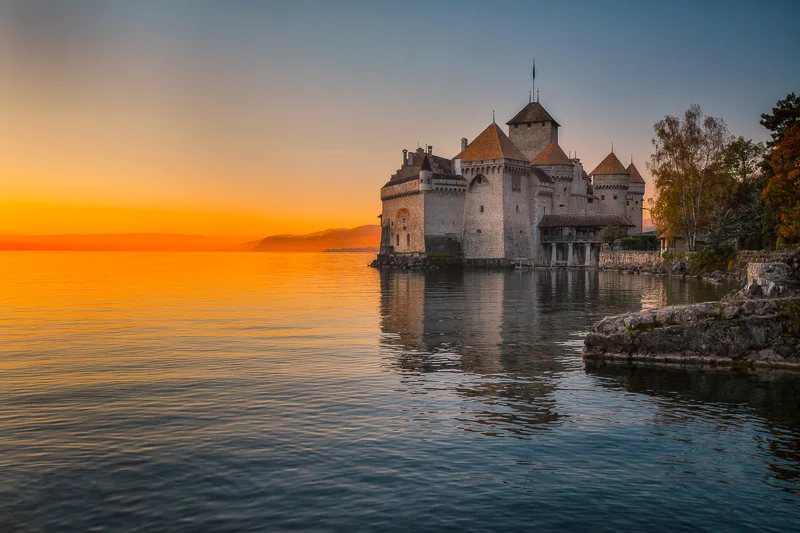
Montreux
A mild strip of lakefront where palm trees grow at the same latitude as Vienna, with a thirteenth-century castle on the water at one end.
Montreux sits at the eastern end of Lake Geneva, in a fold of hills that shelters it from the north wind. The result is a microclimate mild enough for palm trees, magnolias and cypresses to grow outdoors at the latitude of Vienna, which is why the nineteenth century built a row of Belle Époque hotels along the water and called it the Swiss Riviera.
The town itself is a strip: a promenade several kilometres long, hotels on one side, lake on the other, and mountains rising behind. Most of what you come for is on that strip or a short walk from it.
Château de Chillon
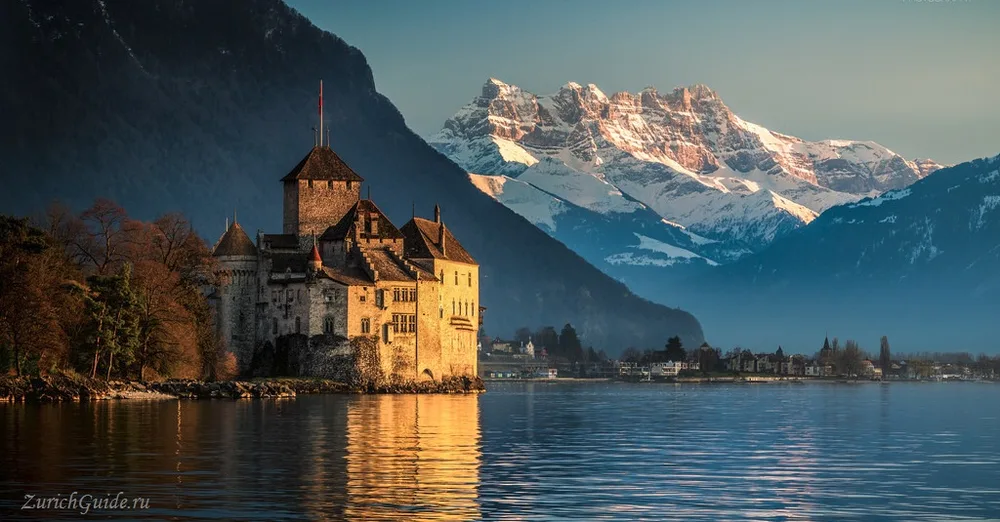
The most visited historic building in Switzerland, and it earns it.
Chillon stands on a rock in the lake connected to the shore by a bridge, three kilometres from the centre of Montreux. There has been a fort here since the Bronze Age; the castle as it stands was built by the Counts of Savoy from the twelfth century to control the road between northern Europe and Italy, which had to pass along this shore.
Inside, some twenty-five buildings around four courtyards: the great halls with painted ceilings, the chapel, the bedchambers, and — the reason most people come — the vaulted underground dungeons cut into the rock, with the lake on the other side of the wall.
François Bonivard was chained down there for four years in the 1530s for supporting Geneva’s independence. Byron visited in 1816, wrote The Prisoner of Chillon, and carved his name into a pillar. The graffito is still there and is now itself an exhibit, which Byron would have enjoyed.
Getting there: bus 201 along the shore, the boat from Montreux pier, or a 45-minute walk along the lakeside path — the last of which is the best, and free.
The lakefront
A promenade runs from Vevey to Villeneuve, planted with subtropical trees and sculptures, and walking a stretch of it is the main activity in Montreux.
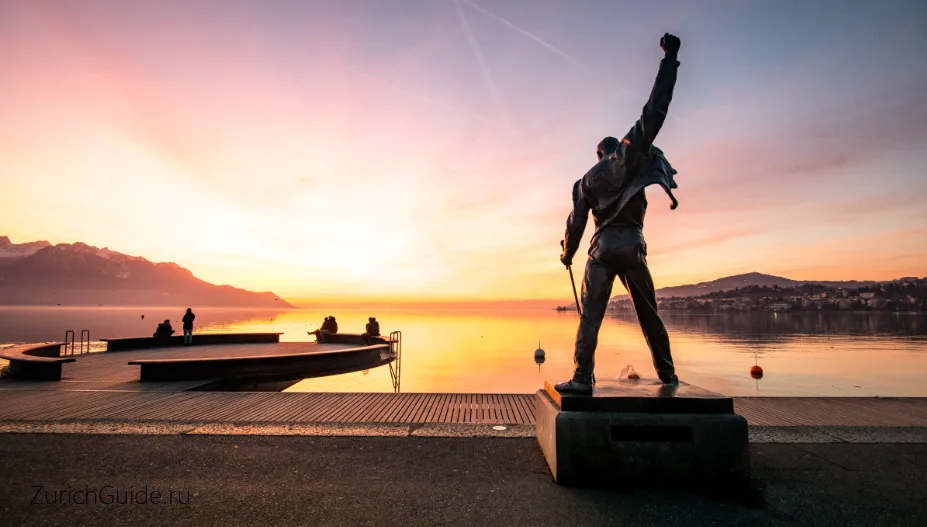
Freddie Mercury lived in Montreux for the last years of his life and recorded here; Queen owned Mountain Studios in the casino building. The statue on the quay, three metres of him with a fist in the air facing the lake, has become the town’s second landmark — there are usually flowers at the base. The studio is preserved as a free exhibition inside the casino.
Montreux Jazz Festival
Two weeks in early July, and the second-largest jazz festival in the world — though “jazz” stopped being accurate decades ago and the bill now runs from blues to hip-hop to whatever is large that year.
It fills the town completely: paid concerts in the halls, free stages along the lakefront, and every hotel bed for thirty kilometres taken. If you want to go, book in the winter. If you do not, avoid those two weeks entirely — prices double and you will not get a table.
Above the town
The Rochers-de-Naye cog railway climbs from Montreux to 2,042 m in an hour, through vineyards and forest to a bare summit with the whole lake below and Mont Blanc across it. There is an alpine garden at the top, and a marmot enclosure that exists mainly for children.
Getting there
- By train — Geneva about an hour, Lausanne 25 minutes, Bern an hour and a half, Zurich about three hours.
- By boat — the Lake Geneva steamers call here from Lausanne, Vevey and Geneva; the paddle steamers are the pleasant way to arrive.
- By panoramic train — Montreux is the southern terminus of the GoldenPass from Lucerne and Interlaken.
What to combine it with
Montreux sits at one end of a very good day:
- Lavaux — the UNESCO vineyard terraces begin immediately west of here, and the walk between the wine villages is the best thing on this shore
- Vevey — ten minutes along the lake, with a good market square and the Chaplin museum in the house where he spent his last 25 years
- Geneva — an hour, at the other end of the lake
When to go
May, June and September — warm, the promenade in flower, and no festival crowds. December brings one of the largest Christmas markets in Switzerland along the lakefront. July is the festival, which is either the reason to come or the reason not to.
Winter is mild by Swiss standards and the lake rarely looks better than under low cloud with the Alps showing through.
Updated: